Monday, February 10, 2014

The Vigilant Christian: Yoga Is a Satanic Practice

Yes, you read that title correctly: the Monday following my in-depth weekend with the Gita, I came across a link to a YouTube video posted by a yoga friend.

The YouTube video was posted by a user calling himself The Vigilant Christian, and as soon as I saw the title of the video (Yoga Is a Satanic Practice), I felt deflated at the idea of yet another Christian giving Christianity a bad rap.

Take a few minutes to watch this video for yourself, and then see what I have to say about it:


Here's the thing: Most of the organized hierarchical religions (cults) will tell you that THIS way is the ONLY way, and that everyone else is lying to you. (Fox News, anyone?) It seems to me that there are lots of Christians out there who don't know anything about Christianity, including how the current version of the Bible was written, and the history of the Christian belief system. (Yes, these things all have roots in socio-political history, they're not just handed down by that God they talk about in the Bible.)

Back in the day (the Medieval Day, mostly), the dogma of the Christian church was developed in order to give power to the priests. The ordained clergy were the ones through which the ordinary person could get to God - and that was important. Since life on Earth was so damn hard for humans, people wanted some kind of assurance that when they died, things would be better. The priests conveniently positioned themselves as that gateway to the Divine - God was portrayed as being separate from humans, and the only way to get God to listen to you was through the priests.

The priests were sort of like insurance brokers. They were the "middle man" that you needed to ensure that you got to Heaven in the afterlife. But Hinduism and many other ancient religions teach that in fact, we are ALL incarnations of the Divine, and it exists right within each of us. We are, in fact, all divine! (Not to mention the fact that the King James Bible, the current book used by Christians to outline their beliefs, was actually written between 1604 and 1611 for political reasons, to allow the Church to hold on to power through their ordained clergy, the same clergy that worked closely with the King and other political leaders of the day.)

There were big bucks involved with the church hierarchy back then, just like today, and no doubt the priests and the political leaders of the day wanted to hang on to all that money. Sadly, that's how most organized religions work: there's just no room for questions that might disprove any of the dogma. In addition to that, practicing yoga doesn't mean that you are now a Hindu, any more than going to church makes you a Christian, or parking yourself in a garage makes you a car.

In case you're now terrified that your asana practice has cunningly turned you into a devout Hindu, never fear: yes, asana practice can be a form of Bhakti - the yoga of devotion to the divine - but the yoga asanas are meant to help someone go inwards, and seek the Divine that exists within themselves. The asanas aren't meant to worship any one particular deity like Lakshmi or Tara or Ganesha - they are meant to strengthen the body and mind to allow one to go deeper within themselves and gently reveal that divine spark that exists within us.

Oh, and in case you were worried that the whole Kundalini serpent was going to allow those demons to sneak into your soul and torture you, you should know that in pretty much every other culture, snakes are regarded as important spiritual symbols, representing transformation, the cycle of death and rebirth, and freedom. Those Kundalini texts that he so conveniently leaves out that talk about Kundalini yoga being a path to compassion, service, and awareness of the Divine were also written at about the same time as the King James version of the Bible he's probably using. But if he can't be bothered to learn the origins of his own belief system, then why should we expect him to do any research at all into other "false religions"?
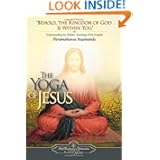
Did anyone else see the big letters at the top of that book, "The Yoga of Jesus"? If this guy actually read his Bible, he would have found this verse in Luke, chapter 17, verse 21: "Neither shall they say, Lo here! or, lo there! for, behold, the kingdom of God is within you." But this, apparently, is just another sneaky way that Satan is out to get you, but presenting you with "false" Christs. This guy seems to believe that our entire existence as human beings is positively fraught with horrible things that will cause our spiritual undoing and eternal torture.

Then, I just started to get sad. When this guy started talking about how we can't trust our heart, can't trust our feelings of great love, even and especially when they occur in a spiritual setting, I just felt really bad for the guy. Why would anyone want to subscribe to a belief system that denies any pleasure at all in this life? Why would you want to believe in a system where God wants you to feel bad? Doesn't Jesus spend, oh, like the entire New Testament talking about how important it is to love? Why would you want to subscribe to a belief system that makes you fearful of love and compassion? Again, it all goes back to the beliefs that were prescribed by the Church hierarchy - you're simply not allowed to feel God's love without the help of a priest, because you, as a human being, are not worthy.

Now, this guy isn't bashing all forms of stretching and strengthening exercise. Apparently, pilates is perfectly okay to do, even though it's all developed from yoga asanas. So, maybe that extra level of dilution makes pilates okay? The illustration at 11:31 in the video is clearly a side plank pose - but because he's got the word "pilates" splashed across it, that makes it compatible with Christianity.

Did I miss something? Pilates has its roots in yoga - and yoga has its roots in the tradition of seeking the Divine in yourself. He says that the word "yoga" means "to yoke to the Hindu gods". So he's getting hung up on a WORD. Four little letters - that actually don't refer to the yoking of oneself to the Hindu gods. It's a yoking of the physical and the spiritual through the practice of meditation. But if this guy can't be bothered to understand his own Christian faith, I guess he can't be bothered to really understand another belief system that differs from his own.

Thinking about the human experience through something like the Bhagavad Gita tells us that while our views and perceptions of the Divine may be skewed because they are limited by our human senses (and the Divine is something much greater that our human brains may have a problem processing in its true form), they are still a part of the greatness. It just reinforces that idea that human beings are not worthy of experiencing spiritual love - and that just makes me sad.
In fact, the more I watched this video, and the more I thought about it, the sadder it made me. This is someone who obviously has a great deal of spiritual passion, but he is denying himself one of the truly most remarkable of the human experiences: that of spiritual love. He is apparently so afraid of reading differing opinions that he has not enabled comments on his video.

What he apparently missed throughout his own yoga teacher training is that even the Hindus recognize just one God. The Hindu deities and incarnations are similar to the incarnation of God as Jesus Christ, or as Muhammad or the Buddha. The difference is that these ancient texts recognize that our human nature is a part of nature - and nature, as we know, is part of the Divine, not set apart from it.

Even the name - "The Vigilant Christian" - is enough to make me feel exhausted. The idea that the whole world is filled with "bad guys" that are out to getcha is full of fear and paranoia. At the beginning of the video, he talks about how he developed depression and anxiety - well, yeah! If I walked around all the time thinking that Satan was lurking around every corner, just waiting to lead me into the destruction of my spirit, I'd probably be pretty damned depressed and anxious, too.

And here's my big thing: when we finally reach that state of enlightenment, that union with the Divine, it is not going to be in a manner that we can perceive with our human senses. Even the Christian belief system understands this. God, Goddess, the Divine - they are all simply manifestations and incarnations of a bigger power that human beings are ill-equipped to comprehend. But we have to start somewhere, right? So Christians have the incarnation of Jesus. Muslims have Muhammad. The Buddha was an incarnation of the Divine, as well. These incarnations give us a starting point, something that we can recognize and that we can  use to develop our own spiritual nature.

Human beings are indeed dual in nature - we are both spiritual and physical. We should be embracing the idea that we, as human beings, as spiritual beings, are all really part of the same great universe. No matter who we are, no matter where we are, we are all the same.

Through the Lens of the Gita

http://www.amazon.com/The-Living-Gita-Complete-Commentary/dp/0932040276/ref=tmm_pap_title_0?ie=UTF8&qid=1392046285&sr=8-1
During the February full weekend of yoga teacher training, we had some incredibly deep dialogue about the Bhagavad Gita.

The Bhagavad Gita is an ancient text, part of the Mahabharata, an ancient Sanskrit epic along the lines of Gilgamesh. It's basically like a "how to" guide for someone seeking enlightenment, or how to follow the path that will led to an experience of the divine.

The story goes something like this: two royal families of ancient India are locked in a power struggle. The first family engages in somewhat dubious practices of deceit and dishonesty in their reign. The other family is pure in nature and actions.

During a game of dice, the family that is pure of actions loses power to the other family. They say, "Okay, you lost power, tell you what: go into the jungle for 13 years, and when you come out, you can have your kingdom back."

Being trustworthy and honest, the family that is pure of heart goes into the forest and survives for 13 years. They come back, but of course, the dishonest rulers tell them that they cannot have their kingdom back.

Two princes, one from each family, are designated to lead each family in an epic battle. The princes decide to call upon Krishna, an incarnation of God or the Divine, seeking help for their side.

Krishna tells the princes that they have a choice: he will offer one side an army of the finest swordsmen and archers, and the other side can have only him - Krishna.

The prince from the family that is pure of heart, Arjuna, chooses to have Krishna for the battle, leaving the other side with a formidable cadre of fighters.

Both sides gather on the battlefield. They are ready to fight.

But as Arjuna surveys the faces of the people against whom he is to fight, he starts to recognize them: they are his cousins, his uncles, his friends, his relatives. He starts to empathize with them, he starts to feel the pain of their loss, of their wounds not yet inflicted.

It's all too much for Arjuna. He falls at the feet of Krishna and cries out, "I can't do this! I can't kill my own kin! What am I to do?"

And that's where the story begins. Arjuna and Krishna out on the battlefield, ready to fight for the vast kingdom of ancient India, and Krishna begins to outline for Arjuna how to live a virtuous life.

When I started reading this particular interpretation of the Gita, I was feeling very low. I was settled in a hot lavender bath to try to calm my nerves, and I started to read... At the point in the story where Arjuna collapses at the feet of Krishna, I started to cry. Right after I started to cry, I picked up my pen and started making furious scribbles in the margins and between paragraphs, jotting down my thoughts as they came.

After the discussion this weekend, I took away a couple of key things for me that I feel like will help carry me forward from now on:

Maybe it's because I'm still recovering from years of Catholic school and being brought up Episcopalian, but for many years now, I've scoffed at the idea of God. The idea that there's some giant man-like deity that decides my fate and sets down strict rules has never sat well with me. There's always been an element of fear involved in the Christian depiction of God: don't break a commandment, we were told in Sunday school, or ELSE.

But reading the Gita gave me an entirely new understanding of God, or the Divine, as I like to call it. God or Goddess, Nature, or simply the Divine, there is a little spark of that love and purity in all things and in all beings, including ourselves.

After years spent studying the Christian Bible in various classes through Catholic school and Sunday school, I was left with the feeling that we had to deny our very humanity in order to become "good" in God's eyes. I was left feeling that so many of the good things about being human were exactly the things that God would condemn us for.

But the Gita isn't like that. The Gita acknowledges our humanity, with all its flaws and our biases that are created through the senses, and tells us that it's okay to be human. That it's perfect to be human, just the way we are, and because we are all Divine, even what we perceive to be flaws are actually beautiful.

The Gita encourages us to view everyone - especially those who are different from us in every way - as being part of the Divine nature of the Universe. Through the lens of the Gita, everyone we meet is to be recognized as having that part of the Divine within them. Everyone we meet is a teacher, everyone has something to share with us, and everything that happens to us can be seen as a positive experience, not as a punishment.

It's this embracing of the wholeness of everything that appeals to me. I especially need to be reminded that there's something of the Divine Spark within all of us, and that we don't need to hide it or be ashamed of it. We are, truly, all connected, with each other, and with everything around us.

Funny, how things like this come up, because scrolling through my Facebook feed the other morning, I saw a link to a YouTube video that was shared by a yoga friend. Almost like my reading the Gita had set me up perfectly to see it.

Tune it for tomorrow's blog to find out about this YouTube video, and see my reaction, all through the lens of the Gita...


Teacher Training: Month 5

I finished my next-to-last weekend of yoga teacher training this weekend, and it was a duzy. One of the other students in the class said on Saturday morning that she could hardly believe that we were five months in, but, yes, we have just one more workshop day in February, and then one more weekend - March 8 and 9 - and I'll have my 200 hour teaching certificate!

I was feeling pretty good when I started the 75 minute flow class on Saturday morning. I knew it was going to be intense, and I paced myself, watching my breath, taking a few child's poses when I needed them, and I felt energized at the end. Then we had the community class, another 75 minute class, which was even better than the flow class - I was really "in the zone" for that one, feeling relaxed, feeling happy while I watched my breath flow in and out...

We had our lunch break, and then went over some basic sun salutations. I love sun salutations - in the summer time, when I can chuck my mat out on the back porch first thing in the morning, I love to welcome the day with a dozen of these flowing movements.

Next we dove into the Bhagavad Gita, and it was INTENSE. I'll go more into that later - it seems that the timing was just right for me for something, apparently - but safe to say the entire discussion left me feeling like a giant hand had just come down and patted me on the back, as if to say, "I love you."

At four o clock, Debbie had us each randomly choose a slip of paper on which she had written a scenario for a yoga class. We had thirty minutes to design a 10-pose sequence of yoga poses that fit the scenario we had drawn, and then we each had a turn teaching it to the class.

The paper I chose read, "Design a 10-pose cool down sequence, ending with Savasana. You want the class to be so relaxed at the end of the sequence that they don't move a muscle during Savasana."

Easy peasy! I know what my current favorite cool down sequence is, so I just used that - started with a nice reclined pigeon pose, went into square pose for some meditation, staff pose to work your entire body a little bit, a nice seated forward fold, a gentle twist, some gentle full-leg stretches, a reclined twist, and then full-on savasana.

I felt *so* comfortable up at the front of the room, and trying to keep my voice in a soothing tone made me feel just as relaxed as they were. I felt like I could have left them in savasana for much longer, but it was almost 6 o clock (quitting time), and there was still one more person to go after me!

The other sequences were not as relaxing, I'll say. Between the two classes in the morning, the sun salutations, and then the five practice scenarios, I don't think I've ever done so many downward dogs in a single day. (My shoulders sure felt like that the next day.)

As I drove home on Saturday, I started to feel the effects of the day's practice in my shoulders, and in my hips and my legs. Owie.

After dinner, I got into a hot shower with a few drops of lavender oil in the bottom of the tub, and then went to bed.

Sunday morning, I wasn't nearly as sore as I had thought I would be, but I was still feeling a little tired. I made it through about 3/4 of the gentle yoga class, and then plopped down into a restorative/supported child's pose with my blankie over my back. And it worked, I felt pretty good for the 75 minute Hatha class right after that.

Started the afternoon discussing anatomy, which I find fascinating. We spent a couple of hours talking about muscle movement, planes of movement, and then took turns getting into poses while the rest of the class dissected what muscles and joints were doing what movements. Something else to think about during my own practice, and when I'm teaching Tom yoga in the evenings now...

Then we went back into the Gita for another couple of hours. I'll save that discussion for my next post, but safe to say it was along the lines of a life-changing read for me.

What's up next? One more practice teach, then trying to set up some free classes so I can get some more experience teaching. And I have lots and lots and lots to think about for my own practice now. Layers, so many layers...

Friday, February 7, 2014

Fighting The Tofu

One of my favorite authors, Natalie Goldberg, talked about "fighting the tofu" in her own Zen meditation practice. I love the analogy - tofu is this white, bland, foul bean curd. (Well, other people don't think it's foul, but I certainly do.) Tofu doesn't do anything but just sort of sit there. So why fight it? It's like you're fighting imaginary tofu, because the tofu isn't doing anything to harm you.

So lately, I'm having this kind of internal fight between my brain and my body. When I get up in the morning, there's a part of my brain that says, "YES! It's early - let's go do some sun salutations!"

But then the remaining part of my brain reaches for my phone or the iPad and says, "No, it's cold in the house. You won't be comfortable. Stay under the blankies a little longer and play with your phone. Besides, Tom will have to get to the wood stove to start a fire, so you can't do yoga in the living room, anyway."

And then I get on with my day. I drop Colden off at school, and I get home, and that first part of my brain says, "HEY! Let's just take half an hour and do some hip stretches!"

That other annoying part of my brain says, "Nah, you've got this and this and this to do. You've got a big to-do list. Forget the yoga."

And so on.

It goes like this for a good part of the day, until finally, Colden is in bed, and then that annoying part of my brain tells me that it's too late to do yoga, and I should just go to bed.

[Insert big sigh.]

I need to start listening to that part of my brain that tells me to take a few minutes to do yoga, whenever it may be. Doing more yoga would be a good thing.

If I listen to the annoying part of my brain long enough, I start to think, nah, I don't need yoga. I fight the urge to drop down into a few sun salutations because I think, "What good is the yoga doing me, anyway?"

Silly, right?

I'm starting to think that the resistance I'm hearing in my head might mean that I'm on to something good here. Just when the desire to quit gets strong, it usually means that I'm on the right track.

I've got teacher training this weekend, but I'm going to try to start listening to that part of my brain that tells me to do more yoga when I first wake up in the morning. What's the worst that can happen? I get healthier? I get happier? I get stronger and more relaxed?


Sunday, January 26, 2014

Practice Teach

Ehrmegerd... It's been over a MONTH since my last post here? Pardon my French, but WTF have I been doing?

Well, let's see.

I was sick as a dog over the holidays. I came down with whatever truly horrible creeping upper respiratory crud was going around, and wound up spending the first 3 hours of Christmas morning (between midnight and 3 am) sitting on the couch, fighting a painful, spastic cough that left my sick and with a throbbing headache for most of Christmas Day. (But I did have enough energy to watch Colden open his presents and get my butt over to Oma and Opa's house for appetizers, more presents, and dinner.)

Then we had this ice storm... Truly bizarre. You drove ten minutes in either direction from our house, and it was like nothing had happened. But here in the valley? Ice on everything. Colden got down on his butt and used it like a sled all the way down the gently sloping hill in the backyard. That lasted for a while, and it was a bugger to get in and out of the driveway, the house, etc., when the entire world was a solid sheet of ice.

Then New Year's came, and we all went back to work and school - until a couple of bad storms resulted in Colden's first official snow day. (That kid was so excited to have school canceled, because, and I quote, it meant he got to stay home with me all day.)

My daily practice kinda sagged for about three weeks there. I mean, I couldn't take a breath without breaking down into a hacking, spastic cough. My lungs felt like they were on bloody fire for a good two weeks. That's no way to keep up a vigorous practice.

I did some restorative stuff during that time, mainly just to let my body rest and heal on its own.

But, then, the second weekend in January, we were back at teacher training, and back into the swing of things!

And now, us teacher trainees are embarking upon our practice teach classes.

I had my first one this past Friday, at 6:30 p.m., at the studio in Keene. And of course, I woke up that morning with - what else? - a freaking chest cold.

No worries! I must have guzzled a gallon of hot tea that day, and just for good measure, I whipped up an enormous pot of kitchari and munched on it all day. (Kitchari is a traditional Ayurvedic food, supposed to be very healing, that consists of basmati rice, mung beans, lots of spices like turmeric, ginger, cumin, cinnamon, and coriander.)

So, I walked in to the studio with my little asana cards and my book on mudras (which is another fascinating subject for future blogs) and my mat, and I was ready to go!

My heart was positively racing when I started class. For a moment, I thought about checking my pulse to make sure I wasn't going to drop dead right there in front of the four students. But, no. I said to myself, not now, and moved on.

I led the class in a slow, flowing, meditative class, and ended in a restorative, supported savasana, complete with eye pillows, bolsters, and blankets.

And you know what I discovered?

An incredible sense of peace.

No, I wasn't one of the people lying in the supported pose with the blankets and bolsters and eye pillows. I was sitting up there, gently guiding them with my voice, into a place of meditation, relaxation and peace.

It was an entirely new sensation for me. A new feeling.

I've never really thought of myself as someone who could bring peace, or as someone who could soothe. To be honest, I've always sort of felt like someone who's better at screwing things up and causing chaos than as someone who can bring relaxation and comfort.

But this? This was totally different. And awesome.

And I bloody well can't wait to do it again!!!

Thursday, December 19, 2013

Pranayama, Or, Learning How to Breathe

We all know how to breathe, right? We do it without thinking, upwards of 20,000 times a day. How often do we slow down long enough to pay attention to what our breath is doing?

I've been immersing myself in the work of Krishnamacharya after being lent a copy of The Heart of Yoga by Debbie, my yoga teacher leading my training program down in Schroon Lake. I also took a 6-week class with my friend Emily, who is enrolled in another teacher training program following the traditions and teachings of Krishnamacharya down in New York City, and what I learned in her class about the breath was just astounding.

For those who aren't familiar with yoga, there are eight limbs to the practice of yoga. Yoga is more than just asana practice (poses). The eight limbs (as outlined in the sutras of Patanjali) are:

  1. Yama. The yamas can be described as how we interact with others. Basically, play nice with others.
  2. Niyama. The niyamas are about how to care for ourselves. Cleanliness, self-study, and surrender to God are all part of the niyamas.
  3. Asana. Asana is the physical practice of yoga poses that most of us are familiar with.
  4. Pranayama. Pranayama, the subject of this blog, is all about breath control. Pranayama is the study and practice of how to connect with your breath and your body and your mind. You'll see why I've suddenly become interested in pranayama in just a few minutes.
  5.  Pratyahara. This is the practice of turning inward, of detaching from our physical senses.
  6. Dharana. Once we have mastered the practice of detaching from our physical senses (not so easy), we are now prepared to tackle the complete detachment from our thoughts. (And you thought pratyahara was going to be difficult!)
  7. Dhyana. The next logical step in achieving our spiritual goal of enlightenment is to practice dhyana, which is the act of concentration without the production of thoughts. 
  8. Samadhi. This is the final stage, the stage of enlightenment and ecstasy, when you are able to transcend self and ego and understand the true nature of the divine.
You'll notice that most yoga classes don't spend a lot of time on the breath, or on the practice of pranayama. But the more I read about Krishnamacharya, the more I'm starting to think that the breath should be mastered BEFORE the study of asana. And here's why...

Krishnamacharya, like most other yoga teachers, instructs students that to be truly comfortable in a pose, they should be able to breathe comfortably.  What does that even mean? How many of us are even aware of when we are breathing comfortably?

Some of us are aware of how it feels when we are breathing uncomfortably. When you are exerting yourself, or you find yourself in a stressful situation with your heart pounding and your head spinning. (Which describes how I felt the first few weeks of the Thursday night vinyasa class. Krishnamacharya, in particular, taught that if you could felt your heart racing or pounding in a particular asana, then that asana was not for you - not yet, anyway.)

So, what does it feel like to breathe comfortably?

This is where the practice of pranayama comes in handy, and where I made my discoveries about breath and movement in my yoga classes with my friend Emily.

I discovered in her classes that even the simplest movements can have a profound affect on both my body and my mind, if I'm practicing them with full awareness of my breath. Raising and lowering my arms above my head can be as powerful a meditation to me as some of my favorite standing balancing poses like Eagle or Tree, if I'm paying attention to my breath.

The true meaning of vinyasa is the linking of breath and movement. But unless you know how to be aware of your breath, unless you can recognize the feeling of a smooth, full, even breath, how can you link your breath with your movement?

Think about it this way: you get into side angle pose. Your left leg is stretched out behind you, your right knee is bent directly over your right ankle. Your left arm is raised, either straight up into the air, or directly over your left ear. Your right arm is either lightly resting on your right knee, or your right palm has found its way down to the floor.

What's your breath doing?

For the first two or three months that I practiced that pose every day, my heart pounded. My breath was NOT smooth and even. It came in big gulps, it was ragged, it sounded like I had just tried to run a 6-minute mile.

After a few months of daily asana practice, I noticed that my breath came easier in side angle pose. (Most of the time.) It was smooth and deep and even. It almost felt like the breaths I take when I'm deeply relaxed, just before sleep.

But I had to practice some pranayama before I was really aware of what that felt like. It was a signal to me that my body and my mind and my breath were, indeed, connected in those few precious seconds.

Now, I'm practicing pranayama all the time. Even on the days when I can't do more than five or ten minutes of asana practice, I'm practicing pranayama at my desk, in the car, while I'm cooking. I'm switching my brain over into pranayama mode, picking one or two of the easier breathing exercises that I'm learning about, and trying to master them.

There are other reasons why I'm getting deeper into the practice of pranayama. I'm finding it intensely helpful during an anxiety attack or a panic attack. I'm also finding that it makes my asana practice more powerful, and allows me to go into a deeper state of meditation when I'm just sitting comfortably on my mat.

Pranayama is making me re-think my whole asana practice, and indeed, my entire practice of yoga. It's making me feel more connected with my body and mind, even on the tough days.

So, for anyone out there practicing yoga or thinking about practicing yoga: start with the basics. Before you dive into your asana practice, start with your breath.

Tuesday, December 17, 2013

Ready to Get Spiritual? F**k It!

http://www.amazon.com/F-k-John-C-Parkin-ebook/dp/B003X4LEHI/ref=sr_1_4?ie=UTF8&qid=1387207947&sr=8-4&keywords=f**k+it
So, I was perusing through some books on Amazon, and after I downloaded the Buddhist Boot Camp book, this little gem popped up in my "You Might Like" list...

And it's called, "F**k It: The Ultimate Spiritual Way".

I know there are probably a lot of people that will be offended just by the title of this book, but you know what? F**k it.

That's how it works!

For a measly $5, I decided to take a chance and download this little gem to my Kindle. I got into a hot bath with a drink and my journal, and started to read.

Now, I'm only a few chapters into this book, but I can totally see how it makes sense.

The basic idea behind the F**k It philosophy is this: in order to achieve enlightenment, pretty much every belief system out there requires you to give up your attachments to things, to people, to outcomes, to whatever.

And sometimes, when we find our stress levels rising, and our tempers flaring, and our patience wearing thin, the best thing we can do to re-gain our perspective is to simply say - you guessed it - fuck it.

Worried about work? Money? Relationships? Fuck it.

Have a to-do list a mile long, and only 24 hours in a day? Fuck it.

Your alarm clock didn't go off this morning, you had a headache, your car wouldn't start, and your bank account was overdrawn? Fuck it.

You get the idea.

I have to admit, I'm inspired by the message in this book. It sort of reminds me of what my father would tell me when I was a kid and getting stressed out about things like school, grades, friends, and all that other stuff that goes into teenage angst. Fuck it!

So this morning, when I felt that little nagging behind my right ribcage that might signal another gallbladder attack, I just took a deep breath and said to myself, fuck it.

And you know, I haven't felt a twinge since.

There are lots more chapters for me to explore in this book, and more to read, and more to report back on, but for now, and especially during the holidays, my mantra is going to be...F**k It!